Why I Published an npm Package Just to Parse a String to a Boolean
FE OSS Edition
June 1, 2026
If you want to start a flame war in a room full of JavaScript developers, just bring up type coercion. We’ve all seen the memes. We all know that [] == ![] evaluates to true, and we’ve all laughed at the bizarre, dark corners of the ECMAScript specification.
Because of this, experienced engineers learn to lean heavily on explicit type casting. We avoid implicit loose equality like the plague, opting instead for built-in constructors to cleanly cast values. If you want to make absolutely sure a value is a true primitive boolean, you just wrap it in the native global constructor: Boolean(value).
It’s foolproof, elegant, and built right into the engine.
Except when you are dealing with configuration strings, environment variables, or feature flags. In those everyday scenarios, JavaScript’s native casting behavior doesn’t just fail—it introduces silent, catastrophic logic bugs that can sit in your production codebase completely undetected.
Here is exactly why native string-to-boolean parsing is fundamentally broken for web configurations, and why I ended up publishing a dedicated npm package just to handle less than ten lines of code.
The Feature Flag Nightmare
Let’s look at a completely standard scenario. You are setting up environment variables or pulling down user feature flags from a remote configuration service. The configuration payload arrives as standard text strings:
const FEATURE_ENABLED = "false";
You want to write a simple conditional check to ensure this feature doesn’t render for the user. Remembering your clean-code principles, you avoid loose checking and explicitly cast the variable:
if (Boolean(FEATURE_ENABLED)) {\n runExpensiveBetaFeature();\n}
Pop quiz: Does the beta feature run? Yes, it does. In JavaScript, the Boolean() constructor operates on a very simple rule: it returns false if a value is “falsy”
(like 0, "", null, undefined, NaN, or an actual boolean false). Every other value is strictly truthy.
Because the string "false" contains characters, it is a non-empty string. To the V8 engine, a non-empty string is a truthy entity. Therefore, Boolean("false") evaluates to true.
To make matters worse, think about what happens when an environment variable isn’t set at all, or a query parameter comes in empty (?debug=). Now you are casting "" or "undefined", which flip-flop behaviors entirely depending on your environment setups. You end up writing a messy, repetitive defensive soup across your entire configuration layer:
const isTrue = (val) => val === 'true' || val === '1' || val === true;
Micro-Packages vs. Ecosystem Bloat
When you find yourself copying and pasting the exact same logic across four different microservices or backend lambdas, the standard developer instinct is to look at npm.
But searching for string parsing or utility helpers usually lands you in one of two places:
-
You install a massive, sweeping utility belt library like Lodash just to use a tiny fraction of its utility functions, unnecessarily inflating your dependency tree and running the risk of broken tree-shaking configurations.
-
You install a heavy, strict validation framework that forces you to define entire schemas just to parse a handful of basic boolean flags.
I didn’t want schema overhead, and I certainly didn’t want transitive dependency bloat. I wanted an ultra-focused, zero-dependency, single-purpose utility whose exact execution path was predictable, explicit, and highly performant.
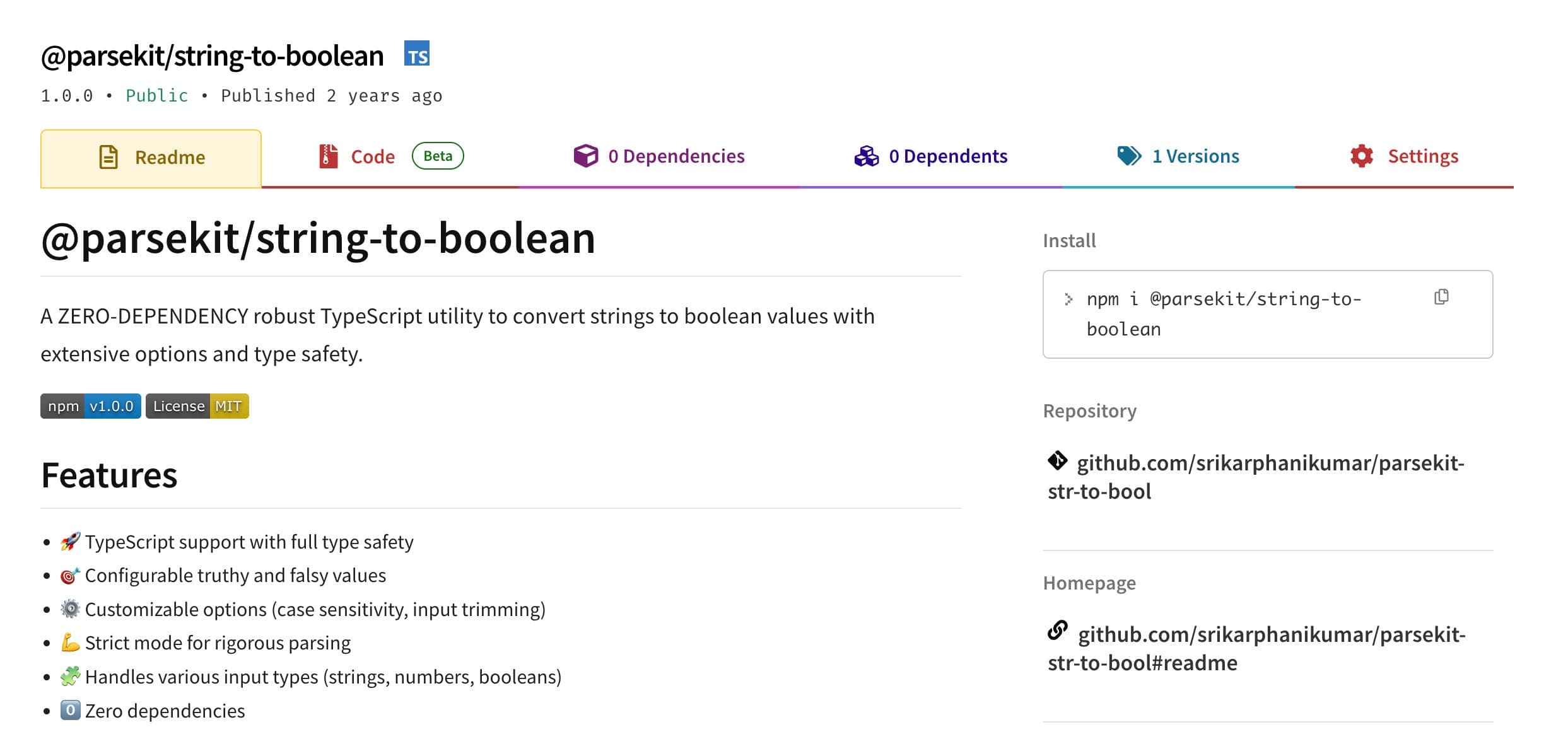
So, I built and published this npm package called @parsekit/string-to-boolean.
Under the Hood of a Single-Purpose Utility
The philosophy behind @parsekit/string-to-boolean is simple: handle the realistic edge cases of text-based environments so you can stop thinking about them.
The utility provides a strict, lowercase-normalized mapping that explicitly matches actual human intent when setting configurations. It doesn’t guess, and it doesn’t rely on loose JavaScript coercion rules:
-
Strict Truthy Targets:
"true","1","yes", and"on"map directly totrue. -
Strict Falsy Targets:
"false","0","no","off", and""map directly tofalse.
import { strToBool } from '@parsekit/string-to-boolean';\n\n// Every single one of these safely returns false\nstrToBool("false");\nstrToBool("OFF");\nstrToBool("0");\nstrToBool("");\n\n// Handled gracefully without throwing or crashing\nstrToBool(null); // returns false
By standardizing these common configuration string representations into a predictable, immutable utility, you remove the mental tax of type coercion entirely from your business logic.
Publishing a package for a few lines of code might look like over-engineering from the outside. But when you look at the sheer volume of silent production bugs caused by JavaScript’s native string coercion quirks, encapsulating that logic into a tested, zero-dependency utility isn’t just about avoiding repetition—it’s about writing predictable software.
You can inspect and download the package directly at @parsekit/string-to-boolean along with the rest of the open-source utility kits.
Thanks for reading Under The Hood! This post is public so feel free to share it.