Transformer Attention Mechanisms: What Happens Inside the Black Box
Peeling back the layers to see how self-attention computes relevance in Transformer models
November 25, 2026
You’re staring at your Transformer model’s attention weights, trying to understand why it fixates on some tokens but ignores others. Maybe you’ve seen heatmaps with bright spots that don’t quite make sense, or your debugging tools show attention heads behaving wildly.
I’ve been there too. Transformer attention often feels like a magical black box , the "secret sauce" that powers huge leaps in language understanding, but one that’s maddeningly opaque when you want to fix or interpret models.
In this post, I’ll walk you through what actually happens inside that attention mechanism , not just the math formulas, but the step-by-step matrix dance that computes how each token looks at every other token. Understanding this will give you a clearer mental model for debugging misbehaving attention and interpreting results.
The Moment You Meet Attention: Query, Key, and Value
Transformers don’t just blindly process tokens; they dynamically weight how important each token is to every other token. That’s the job of the attention mechanism.
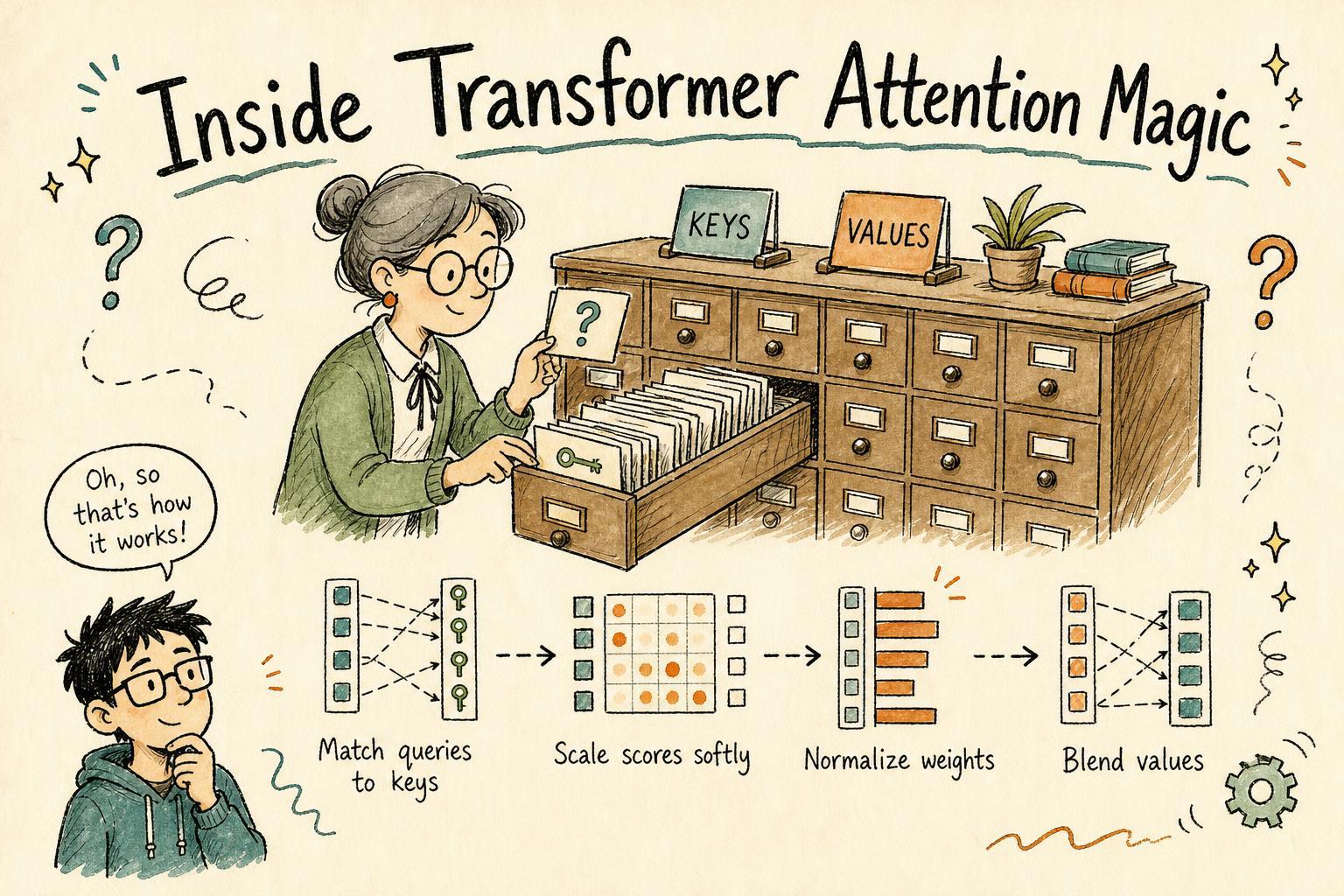
At its core, attention is about matching queries with keys to get weights, then using those weights to combine values. It’s like a search system inside the model:
- The query is what you’re looking for.
- The keys are the items you’re searching through.
- The values are the info you actually want to retrieve.
Every token in the input sequence has its own query, key, and value vectors, which are learned projections of the token’s embedding.
If you’ve seen the formulas:
Attention(Q, K, V) = softmax(QK^T / sqrt(d_k)) V
That’s just a compact way of saying:
- Compute dot products between each query and all keys.
- Scale by the square root of key dimension to keep numbers stable.
- Apply softmax to get normalized weights.
- Use these weights to take a weighted sum of the values.
But what does this look like in practice?
Walking Through the Matrix Operations
Imagine your input sequence has length N and each vector (query, key, value) has dimension d_k or d_v.
-
You start with three matrices:
- Q: shape (N, d_k)
- K: shape (N, d_k)
- V: shape (N, d_v)
-
To get the relevance scores, you multiply Q by K transpose:
- Q (N x d_k) times K^T (d_k x N) produces a (N x N) matrix.
- Each element [i, j] in this matrix is the dot product between the query vector of token i and the key vector of token j.
- This tells you how strongly token i attends to token j.
-
Then you scale these scores by dividing by sqrt(d_k). This scaling prevents the dot products from growing too large and pushing the softmax into regions with very small gradients , stabilizing training.
-
Next, apply softmax row-wise to turn each row into a probability distribution. This means every token’s attention over all tokens sums to 1.
-
Finally, multiply this attention weight matrix (N x N) by the value matrix V (N x d_v) to get the final attended representations. This blends the values from all tokens according to their attention weights.
Why Queries, Keys, and Values Are Learned Projections
Instead of using the raw token embeddings directly, the model learns different linear projections to form Q, K, and V. This helps specialize the roles:
- The query projection learns what to look for.
- The key projection learns what each token represents as a lookup key.
- The value projection captures the information to pass along.
These projections are just weight matrices trained end to end with the rest of the model.
Multi-Head Attention: Multiple Perspectives
One neat trick is to run several attention mechanisms in parallel, called "heads." Each head has its own Q, K, V projections.
Why? Each head can focus on different types of relationships. Maybe one head looks at syntax, another at named entities, and another at long-range dependencies.
In practice, this means you have multiple sets of Q, K, V matrices, compute attention separately for each, then concatenate and project the outputs back into a single vector per token.
What This Means For Debugging and Interpretability
Knowing these details helps when you’re trying to understand what attention heads are doing:
- If an attention heatmap looks random, it might be because the learned Q/K projections haven’t specialized yet.
- Sharp peaks in attention weights mean the query is highly focused on specific keys.
- Uniform attention means the query isn’t discriminating well.
You can also inspect Q, K, and V matrices directly during debugging to see how their distributions evolve during training or inference.
Common Gotchas and Surprises
-
Scaling before softmax is crucial. Missing or changing the sqrt(d_k) factor can cause softmax to saturate and gradients to vanish.
-
Attention weights don’t sum to 1 across columns, only rows. Each token’s attention over all tokens sums to 1, but columns sum can vary.
-
Masked attention (like in autoregressive models) sets some dot products to -infinity before softmax, effectively zeroing out attention to future tokens. This masking happens inside the dot product matrix before softmax.
-
Values shape matters. The dimension of value vectors can differ from queries/keys. Sometimes it’s the same, sometimes not.
-
Attention is a weighted average, not a selection. Even tokens with low attention weights contribute a little to the output.
Wrapping This Up
Next time you stare at attention heatmaps or debug Transformer output, remember that behind the scenes, each token is computing a complex weighted average of all other tokens’ value vectors , guided by learned queries and keys, scaled and normalized through softmax.
This matrix multiplication choreography is what lets Transformers flexibly attend to context, capture long-range dependencies, and power everything from language translation to code generation.
Understanding these steps demystifies the "black box" and gives you tools to peek inside, interpret, and troubleshoot your models more confidently.