Size Doesn’t Matter: Why a 39M Parameter AI Model Is Slower Than a 110M One in the Browser
CWV X AI Edition
May 27, 2026
If you hang around frontend engineering circles long enough, you’ll notice we have a universal rule of thumb for optimization: smaller is better. Smaller bundle sizes mean faster time-to-interactive. Smaller image assets mean lower layout shift. Smaller dependency trees mean fewer node_modules headaches.
Naturally, when web developers start migrating machine learning models to run client-side via WebAssembly and ONNX, they carry this exact same mental model with them. The assumption seems bulletproof: a model with fewer parameters has a smaller file size, requires less compute, and will keep the browser interface fast and responsive.
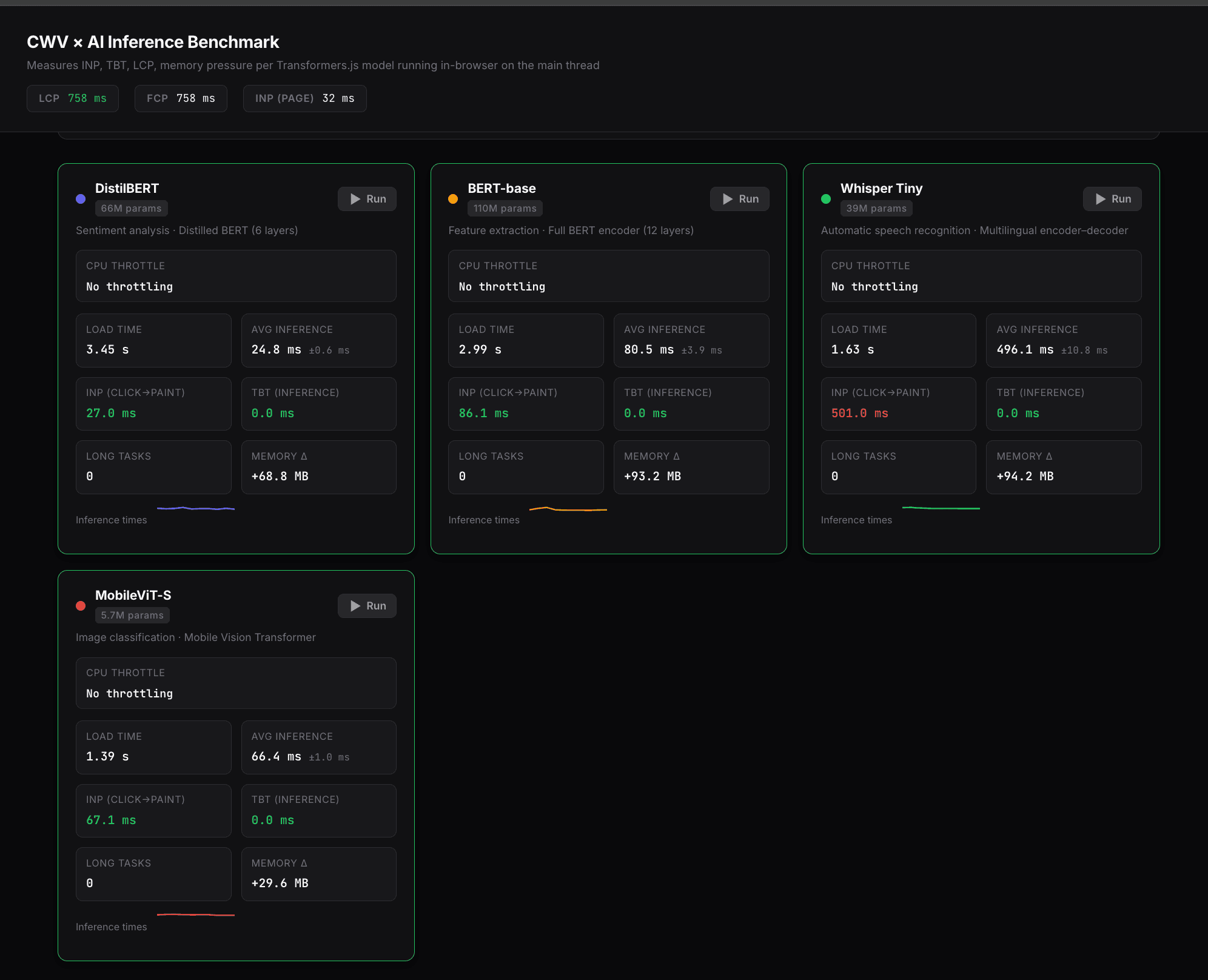
I recently ran a systematic benchmark capturing the Core Web Vitals impact of browser-native neural networks across multiple device profiles. When I looked at the data, this “smaller is faster” assumption didn’t just crack—it completely shattered.
Let’s look at two specific models from the benchmark to understand why raw size is a terrible predictor of frontend performance, and why a model with a third of the parameters can completely freeze your user interface.
The Contenders: BERT vs. Whisper
To see this paradox in action, we can compare two popular quantized INT8 models evaluated in the study:
-
BERT-base: A powerhouse model used for text feature extraction. It packs a heavy 110 million parameters.
-
Whisper Tiny: A lightweight model used for automatic speech recognition. It packs just 39 million parameters.
If parameter count dictated speed, BERT-base should be the heavy, sluggish giant, and Whisper Tiny should be the nimble, lightweight sprinter.
But when you run them synchronously on the browser’s main thread and measure the Interaction to Next Paint (INP) equivalent—the time it takes for the browser to yield control back to the layout engine to paint a frame—the reality is completely inverted.
Here is the unthrottled performance comparison on a premium Android device (a Samsung Galaxy Z Tri Fold):
-
BERT-base (110M params): 164.3 ms (Classified as “Good” by Google UX standards)
-
Whisper Tiny (39M params): 947.4 ms (Classified as “Poor”—nearly a full second of complete UI lockup)
Despite being nearly three times smaller in parameter size, Whisper Tiny is roughly six times slower in the browser. It gets significantly worse under CPU throttling meant to simulate mid-range or budget mobile devices, where BERT-base takes about a second, but Whisper Tiny hits a catastrophic 6,535 ms.
Why? Because quantization down to INT8 compresses the weights on disk, but it cannot rewrite the fundamental mathematical rules of how an AI architecture executes.
The Culprit: The Autoregressive Decode Loop
The dramatic speed difference isn’t a optimization problem or a library bug. It is an inherent architectural constraint.
BERT-base is an encoder-only transformer. When you pass it a sequence of text, it processes all tokens in parallel. It executes a single sequence of matrix mathematics (a forward pass) and immediately spits out the result. It enters the main thread, does its job all at once, and exits.
Whisper Tiny is an encoder-decoder transformer. Audio processing requires it to translate acoustic features into sequence tokens step-by-step. This introduces the ultimate enemy of single-threaded JavaScript: the autoregressive decode loop.
When Whisper processes an input, it doesn’t just run a single forward pass. Instead, it executes a continuous loop:
-
It passes the audio context through the encoder.
-
The decoder runs a forward pass to predict the very first token (word/syllable).
-
It takes that newly generated token, appends it to the previous input, and runs a completely new decoder forward pass to predict the second token.
-
It repeats this entire cycle sequentially, token by token, until it hits an end-of-sequence marker.
If a sequence results in 50 tokens, Whisper has to run its decoder math 50 times sequentially on your main thread. Even though a single pass of Whisper Tiny takes less computing power than a single pass of BERT, repeating that calculation dozens of times in a blocking loop leaves the browser entirely unable to process user clicks, render animations, or paint layout changes.
The Architectural Takeaway for Frontend Engineers
As client-side AI adoption grows, we have to update our engineering intuition. When evaluating models to integrate into user-facing web interfaces, stop looking exclusively at the file size or the parameter count.
Instead, categorize your AI features by their underlying architectural pattern:
-
Parallel Execution Paths (Encoder-only): Text classification, sentiment analysis, and embedding generation can often run fast enough to remain on the main thread for high-end desktop setups, though mobile still demands tight performance budgets.
-
Sequential Execution Paths (Encoder-decoder / Autoregressive LLMs): Audio transcription, text translation, and text generation are fundamentally incompatible with synchronous main-thread interaction patterns.
If your feature relies on an autoregressive loop, it doesn’t matter if the model is advertised as “Ultra-Lite” or “Tiny”. The sequential loop will block the main thread, trash your Core Web Vitals, and alienate your users unless it is explicitly offloaded into a Web Worker.
In the next post, we’ll look at the exact performance limits of encoder-only models, tracing the specific boundary line where a text-based AI feature crosses over from a safe user experience into an SEO liability.
The full open-source benchmark harness used for this study is available on GitHub at srikarphanikumar/cwv-ai-benchmark. You can run the live suite on your own hardware at benchmark.mspk.me. Full academic paper published on Zenodo.
Thanks for reading Under The Hood! This post is public so feel free to share it.