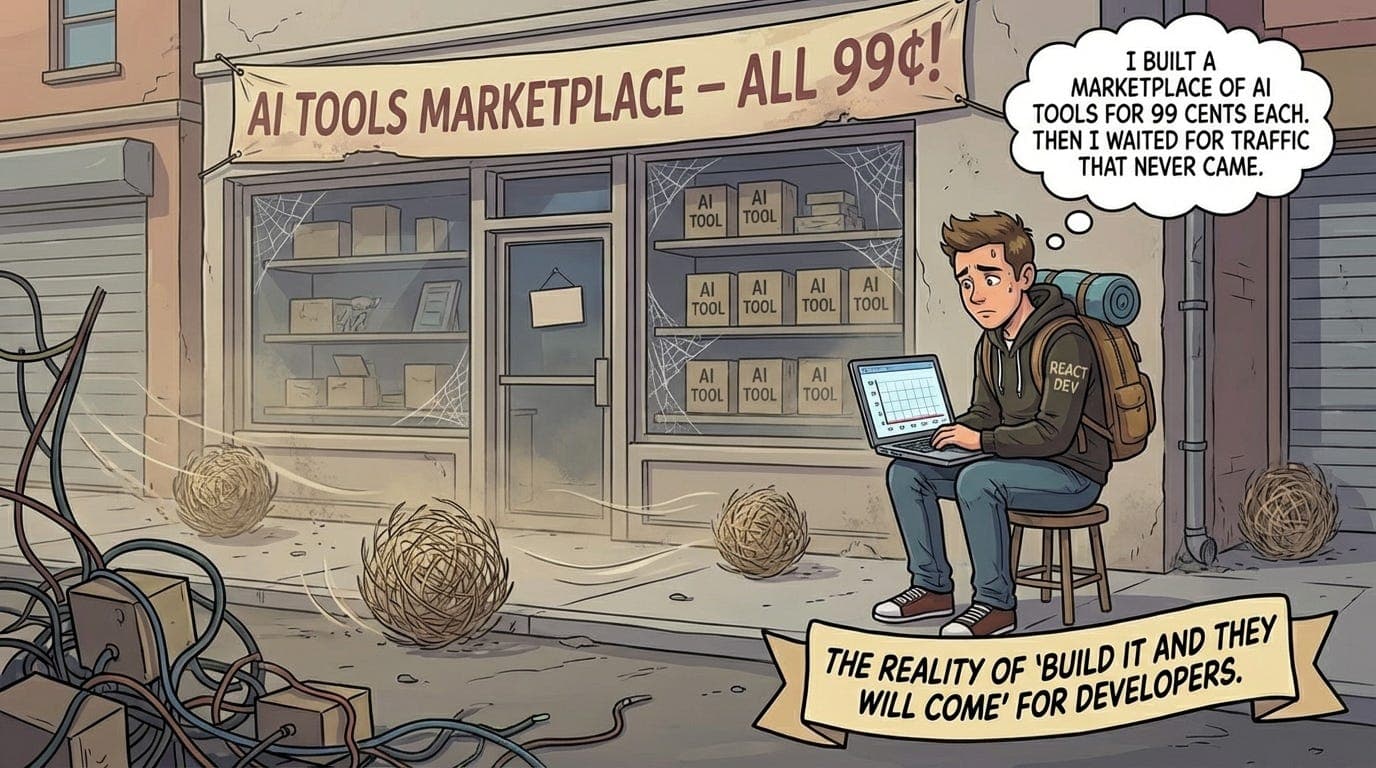
I built a marketplace of AI tools for 99 cents each. Then I waited for traffic that never came.
Solo founder edition
March 30, 2026
Let me tell you about the moment the idea clicked.
I needed to summarize a PDF. Nothing exotic — a long report, wanted the key points, didn’t want to read the whole thing. So I went looking for a tool. Found one. Clean UI, did exactly what I wanted. Pricing page: $80 a year.
Eighty dollars a year to summarize the occasional PDF.
I closed the tab.
I don’t need a PDF summarizer every day. I don’t need it every week. I needed it right now, once, for this one document. A subscription makes no sense for that. But that’s the only option the market was offering — pay for the whole year or figure it out yourself.
That’s when I started thinking: what if you could just pay for the thing you need, when you need it, and nothing else?
The $0.99 idea
The number isn’t arbitrary. It’s low enough that the decision is instant — you don’t think about it, you just pay. It’s below the “is this worth it” threshold that every subscription triggers. And it’s high enough to cover costs and not feel like charity.
The model is simple:
-
no accounts,
-
no subscriptions,
-
no “start your free trial.”
You show up, you need something done, you pay 99 cents, it gets done. That’s the whole product.
I built it for a specific kind of person. Not power users. Not teams with budgets and procurement processes. The content creator who needs captions for one post. The developer who needs mock data for a prototype. The student who wants a document summarized before a meeting. People who have a one-time need and don’t want to pay $20 a month to solve it.
Subscription fatigue is real. The average person is already paying for Netflix, Spotify, cloud storage, maybe a design tool, maybe a writing tool. The idea of adding another monthly charge — even a small one — for something they’ll use twice is genuinely off-putting. A 99 cent one-time charge is a completely different psychological transaction. It’s closer to buying a coffee than signing a contract.
What I built
The platform is toolsfor99cents.com. It has two categories of tools.
Paid tools — 99 cents per use:
-
mockdata-generator — generates realistic mock data for developers building and testing things. Names, emails, addresses, phone numbers, whatever shape you need. This one made the most sense to me as the first tool to build because the use case is specific and repeatable. You need mock data when you need it, and then you don’t need it for weeks.
-
ideaspark-ai — you give it a topic and it generates 5 to 20 ideas for your next video, startup, or project. But it goes further than a list: for each idea it tells you what an MVP would need, scores how easy it is to build, how easy it is to monetize, who the competitors are. It’s the brainstorming session you’d have with a smart friend, for 99 cents.
-
summarize-ai — paste in a PDF or a document, get a clean summary. The alternative is an $80/year subscription you’ll use four times. This one is the tool that triggered the whole idea in the first place.
-
captiongen-ai — give it a topic or an idea (or) a youtube URL (or) a video idea and it generates captions for every major social platform in one shot. Instagram, Twitter/X, LinkedIn, TikTok — formatted correctly for each. Content creators posting across platforms do this manually or pay for tools that want a monthly fee for the privilege.
Free tools — no charge, no ads:
A handful of developer utilities that do one thing cleanly without making you sit through ads or sign up for anything.
Small things that developers Google constantly and deserve a clean, fast, no-nonsense answer.
What happened after I launched
Nothing, mostly.
I built it. I put it up. I waited. Traffic didn’t come.
This isn’t a pivot story or a comeback arc — at least not yet. The platform is early. Barely any traffic. The tools work, the pricing model makes sense to me, and I genuinely think the idea is good. But “the idea is good” and “people can find it” are two completely different problems, and I solved the first one without really thinking about the second.
I didn’t market it. I didn’t write about it. I didn’t post about it. I did the thing that almost every developer does with side projects: I built it and hoped that being useful would be enough. It wasn’t. It almost never is.
The hard truth about building tools on the internet is that distribution is the product. You can have the best solution to a real problem and it can sit completely undiscovered because nobody knows it exists. SEO takes time. Word of mouth requires mouths. Social media requires showing up consistently, which is its own full-time job.
I’m writing this article partly because I believe in the idea and partly because writing about it is the marketing I should have been doing from the start.
Why I still think the model is right
Subscription fatigue is only going to get worse. The SaaS playbook of the last decade — land with a free tier, convert to monthly, raise prices, add seats — is running out of road. People are auditing their subscriptions now in a way they weren’t three years ago. They’re canceling things. They’re looking for alternatives.
The pay-per-use model isn’t new — it’s actually how a lot of the pre-SaaS software world worked. You paid for what you used. The cloud and the subscription model disrupted that, and it was genuinely better for a while. But for a specific category of tools — things you need occasionally, tools with clear one-time use cases, utilities that solve a problem once and go away — the subscription model is a bad fit that the market hasn’t corrected yet.
That’s the gap I’m building in. Whether I can actually reach the people who would pay 99 cents for something they’d otherwise pay nothing for (and just go without) or $80/year for (and feel vaguely guilty about) — that’s the real challenge. Not the tools. The reach.
What’s next
More tools. More writing. More showing up.
The free developer utilities exist partly because developers are a community that shares things. A clean, fast, no-ads JWT decoder that just works — that gets bookmarked, shared in Slack, mentioned in a Discord. It’s a slow way to build awareness but it’s an honest one.
The paid tools need a different channel. Content creators need to know captiongen-ai exists. Developers need to know about the mock data generator. Students and researchers need to know they can summarize a document without a subscription. That’s a marketing problem, and I’m finally treating it like one.
If any of this sounds like something you’d use — or something you’d send to someone who would — toolsfor99cents.com is where it lives. No signup required to look around. 99 cents if you want to use something.
That’s still the whole deal.
The tools: mockdata-generator, ideaspark-ai, summarize-ai, captiongen-ai — all at toolsfor99cents.com. Free utils: JWT decoder, UUID generator, JSON to CSV converter — same place, no charge.
Thanks for reading Under The Hood! Subscribe for free to receive new posts and support my work.